Nearly 1 in 4 U.S. adults ages 65 and older falls each year, says the CDC. This is why tai chi walking is often talked about in health talks and on social media.
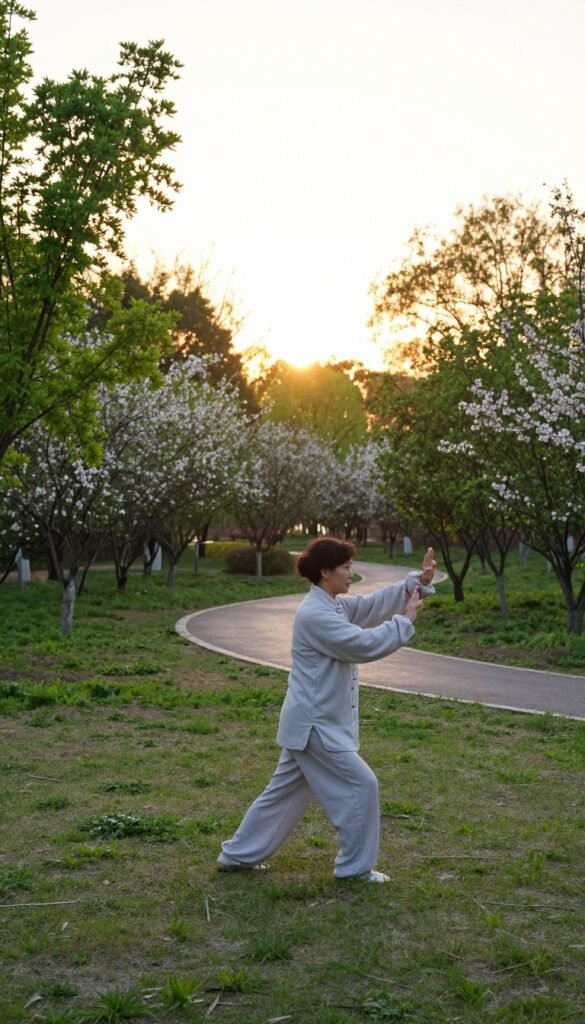
So, what is tai chi walking? It’s a way of moving that slows you down. Each step is controlled. People say it’s like walking, but with balance training and mindfulness.
It’s easy to fit into your daily routine. You don’t need special equipment. You can do it anywhere, like on a sidewalk or in a park.
Online, some say tai chi walking is a magic solution. But it’s better to see it as a way to add calm and body awareness to your walks. We’ll explore how tai chi walking can make your walks better, without the hype.
Tai Chi Walking Explained: a mindful walking method inspired by tai chi movements
What is tai chi walking? It’s a slow walk that uses tai chi movements. Each step is a mindfulness practice, focusing on balance, breath, and posture.
How It Differs From Traditional Tai Chi Practiced Mostly In Place
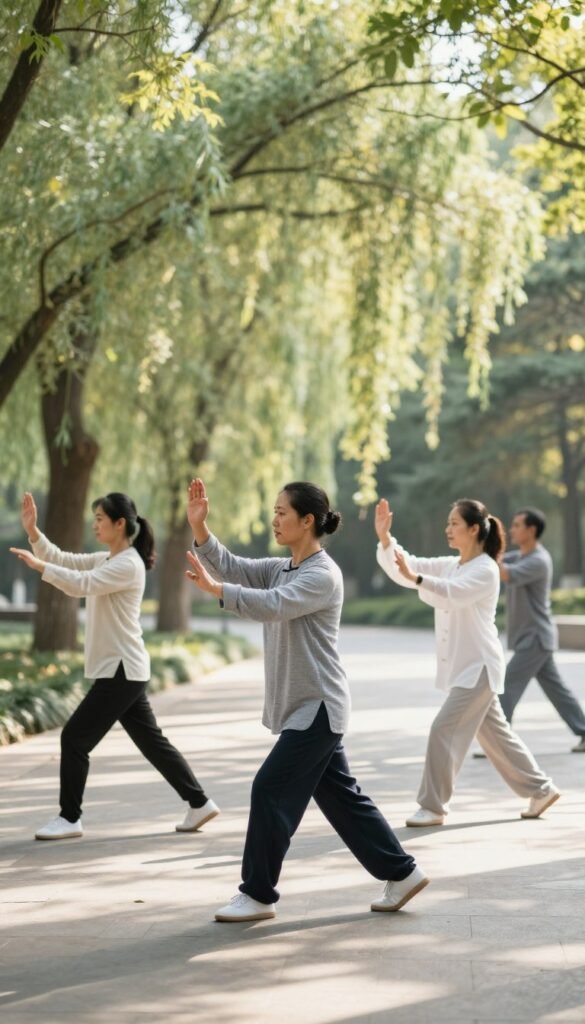
Traditional tai chi is done mostly in one spot. You move, turn, and settle into stances. Tai chi walking takes this and moves it across the floor.
Unlike traditional tai chi, you don’t hold poses. Instead, you keep moving. This makes your steps feel connected.
Why There’s No Single “Pure” Tai Chi Walking Form, But Clear Tai Chi Roots
Online, you’ll find many versions of tai chi walking. There’s no one “right” way. But, they all share tai chi roots.
These roots include a slow pace, upright posture, and calm focus. Some add simple arm movements to match their legs.
The Core Idea: Slow, Intentional Weight Transfer And Controlled Transitions
The key to tai chi walking is the transition. You move between stances, transferring weight on purpose. Keep your hips steady as you step.
It’s a slow, careful walk. Done right, you’ll see tai chi in the smoothness of your steps and balance.
| Focus point | Traditional tai chi (mostly in place) | Tai chi walking (traveling method) |
|---|---|---|
| Main goal | Refine alignment inside stances and turns | Carry the same tai chi movements into forward motion |
| How you advance | Small shifts with limited travel | Extremely slow steps that cover ground on purpose |
| What you pay attention to | Centering, rooted feet, coordinated torso rotation | Weight transfer, foot placement, and controlled transitions as a mindfulness practice |
| Common visual cue | Clear stances, then a turn or shift to the next | Continuous “in-between” movement, sometimes with gentle arm sweeps |
What Is Tai Chi Walking?
Many people wonder about tai chi walking when they see it. It seems like just walking, but it’s different. Each step is a calm, steady drill that’s part of a gentle exercise routine.
What you’re doing with your feet, hips, and posture during each step
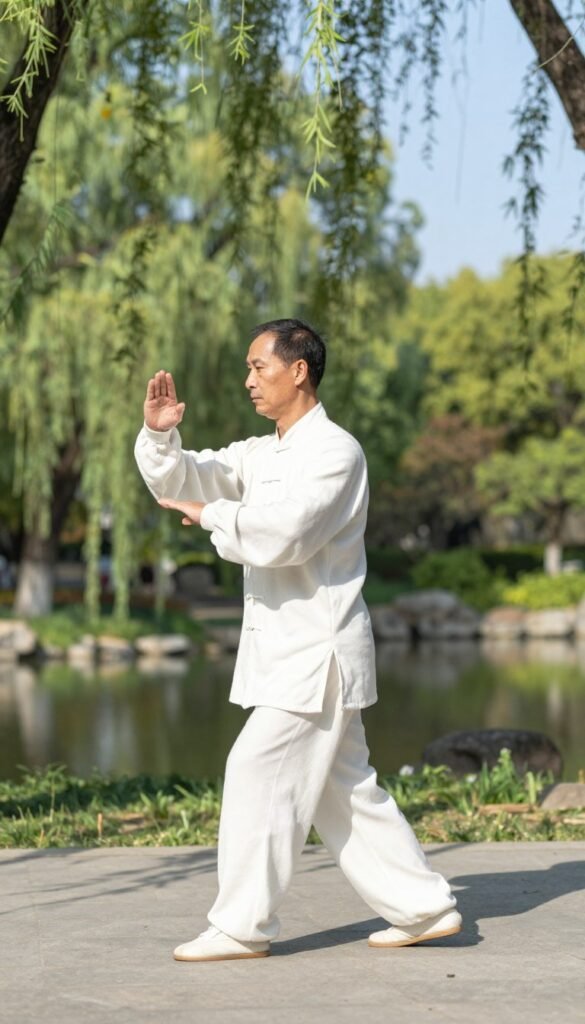
Start with your knees slightly bent and feet under your hips. Move your weight back onto your rear foot. Turn your front foot a bit outward.
Keep your back straight and chin a bit down. Your shoulders should be relaxed.
Slowly move your rear foot forward. Let your toes touch down first. Then, roll your foot toward your toe as you transfer your weight.
Try to sink through your waist and hip without using momentum. This is where tai chi exercises come in. You focus on control, alignment, and smooth transitions.
How to blend tai chi walking into a regular walking routine
You can add tai chi walking to your usual walk without changing your path. Use it as a warm-up or during a quiet part of your walk. Choose a pace that keeps you upright and relaxed.
Try alternating: one minute of tai chi walking, then two to three minutes of regular walking. Over time, these mindful minutes can become a reliable part of your routine. They fit into errands, park walks, or a lunch break.
| Walking style | Main focus | Simple cue to use | Best time to do it |
|---|---|---|---|
| Tai chi walking | Weight shift, posture, and controlled stepping | Heel first, roll forward, stay tall | Warm-up, cool-down, or calm parts of a longer walk |
| Regular walking | Distance, pace, and daily movement | Natural stride, easy breathing | Commutes, fitness walks, and steady mileage |
Typical Session Length: Short Practices You Can Repeat Consistently
Most people do 5–10 minutes at a time. Start with two or three minutes if you’re new. Repeat it once or twice a day. Consistency is key, not long sessions.
As you get more comfortable, you can add a few more minutes. Or you can mix it into a longer walk. When asked about tai chi walking, tell them it’s a practice that trains steadiness and attention through small, careful steps.
The origins of tai chi and why walking variations are trending in the United States
Tai chi started in China many years ago. It was a martial art that mixed self-defense with calm focus and breathing. These roots are seen in tai chi today, even when it looks easy.
In the U.S., people often learn tai chi in health classes. It’s seen as safe and easy, making it popular for older adults. This is why wellness groups often include it.
What is tai chi walking today? It’s a walking version that keeps the same calm focus. It’s perfect for busy people because you can do it anywhere.
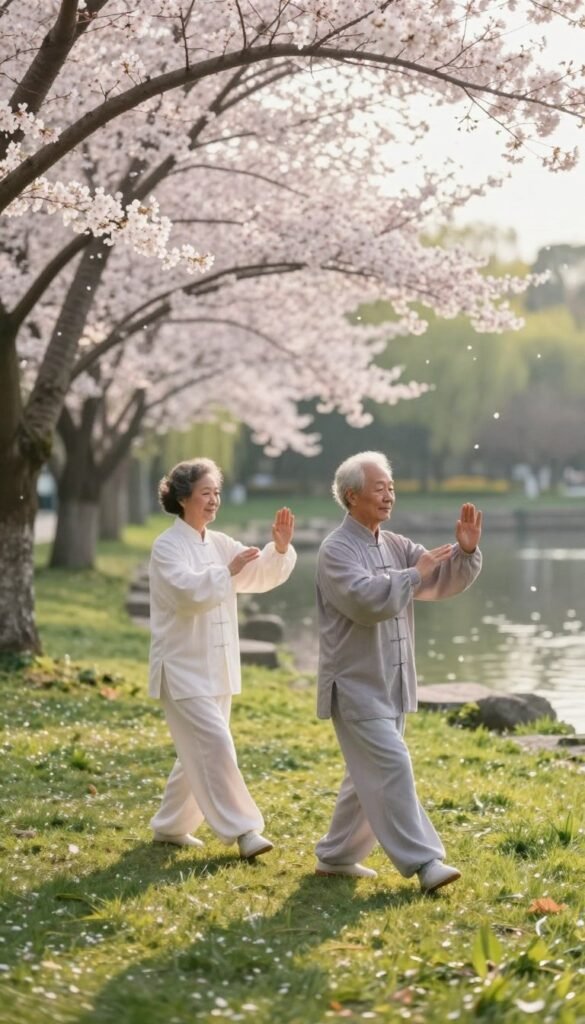
Social media has made tai chi more popular. Short videos make it easy to learn and share. This helps people find wellness routines online.
Tai chi is more than just a set of steps. It has many forms and styles. So, what is tai chi walking can change, showing the variety in tai chi.
| Traditional tai chi training roots | Why walking variations fit U.S. habits | What tends to stay the same |
|---|---|---|
| Martial intent, structure, and timing developed for practical use | Easy to add to daily walks, senior centers, and wellness classes | Slow control, aligned posture, and clear weight shifts |
| Practice includes solo forms, stance work, and sometimes partner drills | Short videos highlight steps and make learning feel less intimidating | Core tai chi movements emphasize smooth transitions over speed |
| Training can include breath, attention, and relaxed power | Walking-based practice supports a consistent holistic wellness routine | Mindful pacing and steady rhythm guide each step |
Tai Chi Benefits You Can Expect From Tai Chi Walking And Other Gentle Exercise Routines
Tai chi walking seems simple, but it’s full of details. Small changes in how you stand, move, and hold your body can make a big difference. Over time, you might notice many benefits that fit well with other gentle exercises.
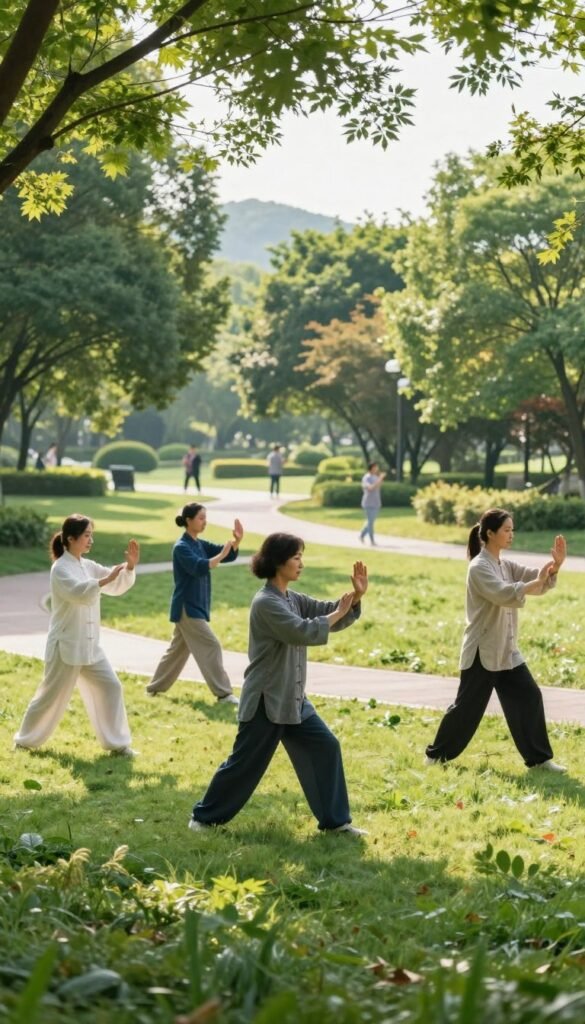
Balance, Strength, And Mobility Support Linked To Fall-Prevention Goals
People stick with tai chi walking for its focus on balance and control. The slow pace requires you to manage your weight and keep your body stable with each step.
Good posture can also make your muscles work harder. A deeper bend and longer stride can challenge your hips and legs more than usual walking or jogging.
For example, Jacques MoraMarco, in his 70s, almost fell when his foot got caught. But thanks to tai chi, he quickly regained his balance.
Mindfulness Practice And “mind intent” (yi): Staying Present In The Body
Yun Kim says yi means “mind intent.” It’s key to tai chi. It’s not just about following steps; it’s about staying focused on your body.
This means feeling your feet on the ground, noticing your weight shift, and keeping your core tight. It turns a simple walk into a mindful exercise.
Potential Mental Wellness Benefits: Stress, Anxiety, And Sleep Support
Studies show tai chi can help with sleep and lower anxiety. Many people find the meditative aspect very helpful.
The calm comes from the repetition and rhythm of tai chi walking. It helps your nervous system relax without forcing it.
Why Outdoor Practice Can Amplify The Experience For Holistic Wellness
Kim also mentions practicing tai chi walking outdoors. Being in nature can make it feel more like a reset than exercise.
Outdoor practice adds sensory details like wind and sounds. These can help you focus and be more aware of your body. It supports holistic wellness in a gentle way.
When tai chi benefits grow with regular mindfulness practice, it’s easier to keep up. And doing it outside makes holistic wellness feel achievable every day.
Tai Chi Walking For Seniors And Anyone Focused On Stability And Fall Prevention
For many older adults, feeling steady is hard. tai chi walking for seniors focuses on slow steps and calm movements. It helps with everyday activities like turning in the kitchen.
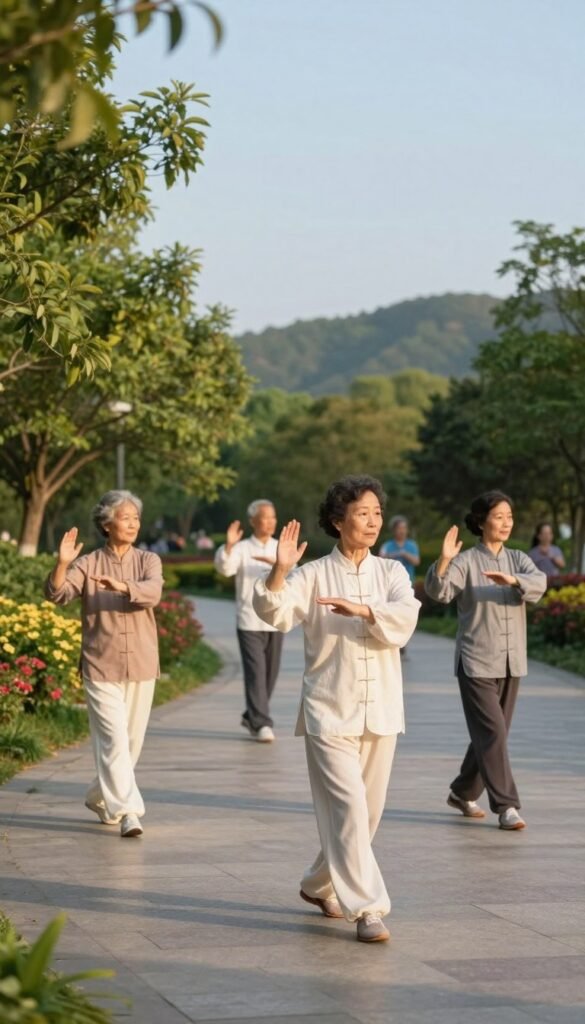
This walking is gentle, perfect for those who don’t want to hurt their joints. You stay alert and keep your body quiet. This helps improve balance in a natural way.
It’s also good for people with chronic pain or limited movement. You learn to soften your knees and keep your spine relaxed. This helps your legs get stronger while keeping your spine straight.
Some people choose tai chi for its weight-bearing benefits. Yun Kim, 53, prefers it over lifting weights. It keeps you moving and supports your bones as you age.
| Stability focus | How tai chi walking is performed | What to pay attention to |
|---|---|---|
| Weight transfer | Shift most of your weight onto one leg before the other foot moves | Feel the whole foot on the ground and keep the hips level |
| Step control | Place the foot softly, then roll through with a steady pace | Keep steps short to reduce wobble and protect the knees |
| Posture and alignment | Stand tall with relaxed shoulders and a neutral head position | Let the arms hang naturally so the torso stays calm |
| Attention and breathing | Move slowly enough to notice each phase of the step | Use easy breathing to stay focused during transitions |
It’s a great exercise to do anywhere. You can practice in a hallway, on a patio, or at the park. The key is to keep it simple and listen to your body.
Tai Chi For Beginners: How To Start Safely With Short, Consistent Practice
Starting tai chi seems easy, but it’s all about the details. Move slowly, keep your knees soft, and focus on smooth weight shifts. This helps seniors with tai chi walking too, where control is key.
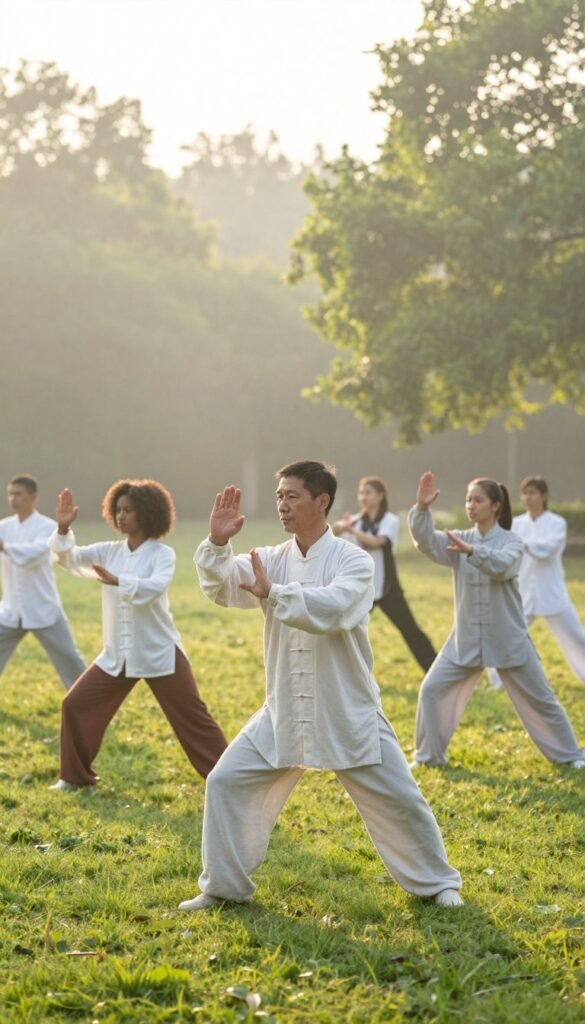
Where to practice: outdoors, indoors, or even in a hallway at home
Find a place where you can walk without rushing. A quiet sidewalk, backyard patio, or flat park path is great. They offer fresh air and fewer distractions.
Indoors is also good for tai chi walking for seniors and anyone who prefers a stable surface. Yun Kim suggests practicing in a hallway at home. It’s easier to stay consistent.
How long to start: building from a couple minutes toward longer sets
Begin with short sessions. Yun Kim and Jacques MoraMarco suggest starting with two minutes. Then, add more time as you get better. Aim for a ten-minute set that you can do most days.
Think of it as a mindfulness practice with movement. It’s not a workout to “win.” Yun Kim says, “Prevention is the highest form of medicine.” It’s about supporting balance and mobility early, not just after problems arise.
| Practice target | Time goal | What to pay attention to | Safety cue |
|---|---|---|---|
| First week routine | About 2 minutes | Heel-to-toe placement and quiet breathing for mindfulness practice | Use a wall or counter nearby if you feel unsteady |
| Building consistency | 4–6 minutes | Even pacing, relaxed shoulders, and level hips | Shorten your stride to reduce wobble |
| Repeatable set | Up to about 10 minutes | Clear weight transfer before each step, no rushing | Stop before fatigue changes your form |
Post-practice reset: using a neutral standing position to re-center
End with wu ji, or “standing like a pole.” Let your arms hang, align your head over your hips, and feel both feet settle into the ground.
This reset helps you end the session with a clean mental shift. It keeps tai chi for beginners focused and calm. This is good for seniors who prefer a gentle finish.
Step-by-step tai chi exercises: the tai chi cat walk technique
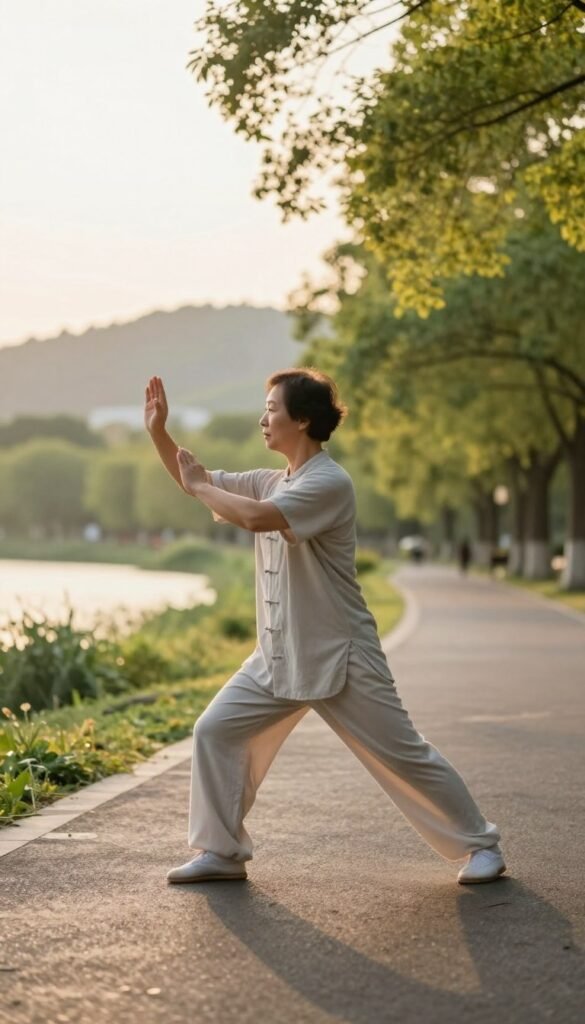
If you’re new to tai chi walking, start with the cat walk. MoraMarco and Kim show several versions, each getting harder. The first one keeps your upper body calm. This helps you feel the movements in your lower body.
Starting Stance: Bow Stance Setup And Posture Cues
Begin in a right bow stance. Your right leg should be in front, with a soft knee. Stack your left leg behind you, also slightly bent.
Put your hands at the top of your hips if it helps you stay balanced. Keep your back straight, shoulders relaxed, and your chin a bit down. Remember, comfort is key in these exercises.
Weight Shift And Foot Angle: Rotating The Front Toes While Keeping The heel Grounded
Lower your waist and right hip, with a small opening to the right. Lift only the toes of the right foot and turn them outward to about 45 degrees. Keep the heel on the ground.
Keep shifting until your full weight is on the right foot. Move slowly so you can feel the weight transfer. This steady change is key in tai chi.
Controlled Step-Through: Lifting, Passing, And Placing The Foot Heel-To-Toe
With your weight on the right, lift the left foot. Bring it forward past the right, keeping your knee bent under your body.
As the foot moves forward, straighten the leg before placing it down heel-to-toe. Aim for a quiet landing and a smooth movement, which is central to tai chi walking.
Mirroring to the other side: finishing in the opposite bow stance and repeating
When the left toes touch, straighten the right leg behind you. Shift your weight onto the left to finish in a left bow stance that mirrors your start.
Continue for a few minutes, aiming for 10 minutes when you feel steady. Keep the same pace and height, so the exercises stay consistent.
| Cat walk checkpoint | What to feel in your body | Simple cue to stay on track |
|---|---|---|
| Bow stance alignment | Stable base, knees soft, pelvis level | Stand tall, sink lightly |
| Toe rotation with heel anchored | Right heel steady, toes open without twisting the knee | Heel stays planted |
| Full weight shift | Clear “100% on one foot” moment before stepping | Finish the shift before you lift |
| Step-through path | Left foot passes close, body stays low and controlled | Slide forward, don’t pop up |
| Heel-to-toe placement | Quiet contact, smoother balance on landing | Heel first, then roll |
| Mirror to the other side | Same stride length and stance depth both ways | Match right and left |
Progressions and tai chi movements: golden rooster and bear walk variations
When you master the cat walk, try the golden rooster or bear walk. These moves keep the slow pace but need more control. For beginners, aim for smoothness, not speed.
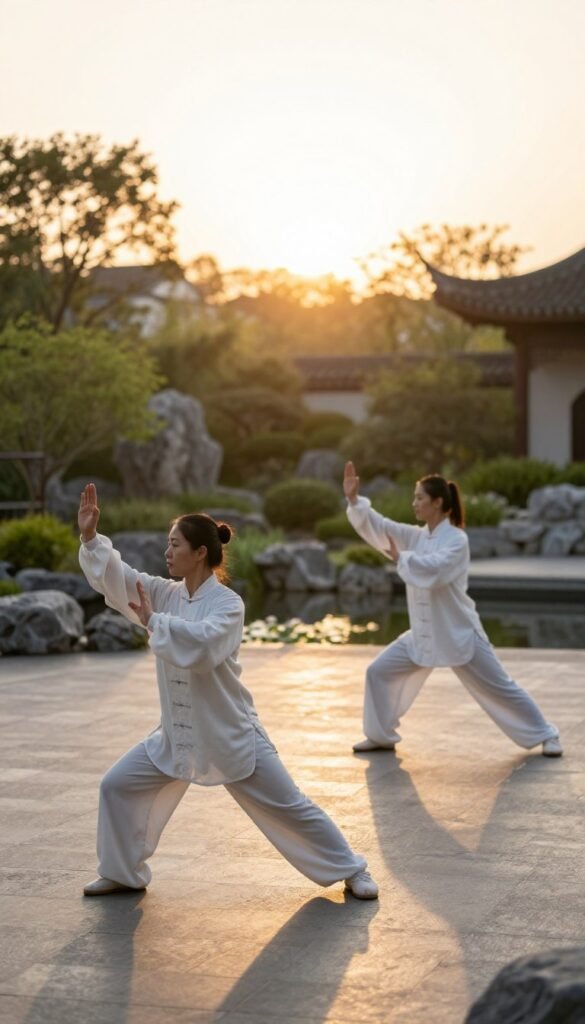
Think of each step as a mindfulness exercise. Keep your eyes soft, jaw relaxed, and weight transfer quiet. This calm focus helps catch small wobbles early.
When to add arm movements and why they increase balance demands
Add arms when your feet and posture are steady. Arms change your balance, making it harder to stay stable. In classes, hands move forward mid-step, like pushing air.
Timing is key. Fast arms can make your step quicken. Keep hands slow and let your foot land first for better control.
Breathwork basics: coordinating breathing with slow transitions
Breathe in sync with your walking. Inhale as you prepare to shift, exhale as you settle. Good breathing makes it part of your practice, not extra work.
If breathing gets out of sync, relax. Go back to natural breathing and rebuild the rhythm step by step.
How to scale difficulty without losing form and mindfulness
To make it harder, focus on precision first. Try narrower steps or pause on one leg. For beginners, “harder” should be controlled and quiet.
The key is always slow, careful steps and focus. If you start to rush, slow down and focus on clean movements that support awareness.
| Progression | What changes | Balance demand | Mindfulness cue |
|---|---|---|---|
| Cat walk | Heel-to-toe placement with measured weight transfer | Moderate; steady base with controlled steps | Feel the sole meet the ground in three quiet phases |
| Golden rooster walk | Longer single-leg moments with a lifted knee and upright spine | Higher; more time spent balancing on one leg | Exhale on the settle, and keep shoulders level |
| Bear walk variation | Lower stance and grounded stepping with coordinated arm swing | Higher; arms and torso shift the center with each step | Move hands slowly, as if the step is carrying the arms |
How tai chi walking compares to regular walking for metabolic health and fitness goals
Finding time for exercise can be tough. Tai chi walking and regular walking are good options. They are easy to fit into a busy day if you keep moving at a steady pace.
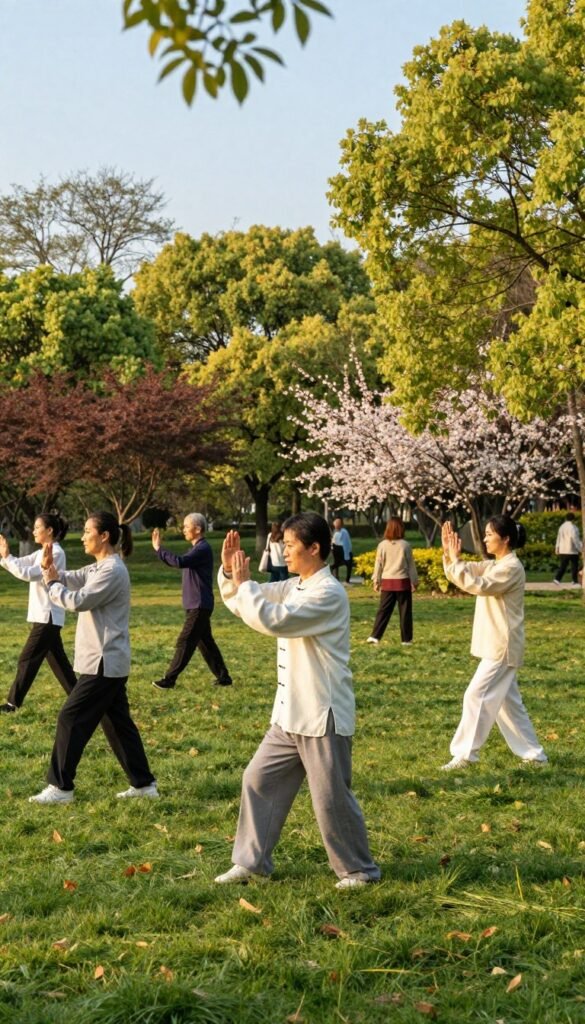
Instead of looking for hard workouts, focus on doing the same thing over and over. This is where tai chi shines. It helps with overall wellness and keeping your energy up.
Moderate-intensity activity you can do in daily life
Studies say tai chi and walking are both moderate activities. They are not too hard but not too easy. You can do them before work, after dinner, or during your lunch break.
Tai chi walking also involves slow movements and controlled steps. This makes walking more mindful. You pay attention to your posture and breathing.
Evidence snapshot from a 12-week program: modest weight and fat-mass changes
A study in Hong Kong looked at 374 middle-aged people. They were divided into three groups: tai chi, walking, and a control group. Each group did their activity for 45 minutes, five days a week, for 12 weeks.
After 12 weeks, the tai chi group lost an average of 0.50 kg. The walking group lost 0.76 kg. Both groups lost about 0.47 kg of fat.
Metabolic markers: waist circumference and fasting blood glucose improvements reported
The study also looked at waist size and blood sugar levels. The tai chi group had a waist size 3.7 cm smaller than the control group. Their fasting blood glucose was 0.18 mmol/L lower.
The walking group had a waist size 4.1 cm smaller than the control group. Their fasting blood glucose was 0.22 mmol/L lower. These changes are important for people who want to improve their health through movement.
Bone mineral density findings: why results may vary and what lean mass suggests
The study found no big differences in bone density or lean mass between groups. But, there was a link between changes in lean mass and bone density. This is important for long-term fitness plans.
This information is useful when comparing tai chi and walking. It shows why a gentle routine can be part of a bigger wellness plan.
| Program detail | Tai Chi group | Self-paced walking group | Control group |
|---|---|---|---|
| Participants (n) | 124 | 121 | 129 |
| Schedule | 45 min/day, 5 days/week, 12 weeks | 45 min/day, 5 days/week, 12 weeks | No training program |
| Average body-weight change after 12 weeks | 0.50 kg loss | 0.76 kg loss | Compared against intervention groups |
| Average fat-mass change after 12 weeks | 0.47 kg loss | 0.59 kg loss | Compared against intervention groups |
| Between-group difference vs control: waist circumference | −3.7 cm | −4.1 cm | Reference group for comparison |
| Between-group difference vs control: fasting blood glucose | −0.18 mmol/L | −0.22 mmol/L | Reference group for comparison |
| Other reported measures vs control | No significant differences for blood pressure, lipids, lean mass, or bone mineral density | No significant differences for blood pressure, lipids, lean mass, or bone mineral density | Used to test differences |
Conclusion
So, what is tai chi walking? It’s a way to walk that focuses on slow movements and careful steps. You aim for smooth transitions, keeping your body and breath in tune.
This method is great for many in the US, from beginners to those seeking a calm routine. It’s perfect for seniors because it improves balance without hurting joints. You can do it indoors or outdoors, making it easy to practice often.
If you like to purchase the complete Tai Chi Indoor Walking DVD from Amazon Click Here
Don’t expect quick results from tai chi walking. The real benefits come slowly, like better balance and focus. Be wary of programs that promise too much too fast or charge extra for things you don’t need.
Begin with just two minutes of slow walking and gradually increase to 10 minutes. Make sure each step is quiet and controlled. End with wu ji, or standing like a pole, to feel centered and balanced.
For other Important Weight loss topic please click Here